
- Overview
- Getting Started
- Quick Start Guide
- Core Concepts
- Users
- Models
- Creating a Model
- Model Card
- Model Card
- Importing Model Card Text
- Comparing Model Cards
- Creating a Release
- Uploading Files
- Uploading Images
- Model Templating
- Data Cards
- Creating a Data Card
- Managing Data Cards
- Using a Model
- Browsing the Marketplace
- Requesting Access
- Using a Pushed Docker Image
- Downloading Files
- Reviews
- Understanding Reviews
- Reviewing
- Reviewing a Release
- Reviewing an Access Request
- Reviewing a Model Card Lifecycle
- Review Outcomes
- Security Scanning
- File Scanning
- Image Scanning
- Inferencing
- Creating an Inference Service
- Managing Inference Services
- Model Mirroring
- Creating a Mirrored Model
- Editing a Mirrored Model Card
- Untrusted Models
- Untrusted Models
- Deletion
- Deleting a File
- Deleting a Model
- Soft Deletion
- Bailo Metrics
- Viewing Bailo Metrics
- Programmatic Access
- Authentication
- Personal Access Tokens
- Python Client
- OpenAPI Reference
- Webhooks
- Administration
- Getting Started
- Deployment Architecture
- App Configuration
- Model Lifecycle Configuration
- LLM
- LLM Import
- Schemas
- Understanding Schemas
- Create a Schema
- Upload a Schema
- Schema Migrations
- Review Roles
- Managing Review Roles
- Assigning Roles to Schemas
- Federation
- Peer Integration
- Microservices
- Artefact Scanners
- Helm
- Basic Usage
- Configuration
- Isolated Environments
- Migrations
- Bailo v0.4
- Bailo v2.0
- DataBase Scripts
- Reference
- Glossary
- Roles & Permissions
- Troubleshooting & FAQ
Comparing Model Cards
Model card comparison allows you to review the differences between two versions of a model card. You can compare versions from the same model or select model cards from different models.
This is useful when reviewing changes to model documentation, checking how models differ, or verifying that updates have been recorded correctly.
Common questions this page answers:
- How do I compare two model cards?
- Can I compare model cards from different models?
- Can I compare different versions of a model card?
- How do I view the differences between model cards?
Selecting model cards to compare
To compare two model cards:
- Open the model history or model card comparison page
- Select two card versions you wish to compare
- Select Compare revisions
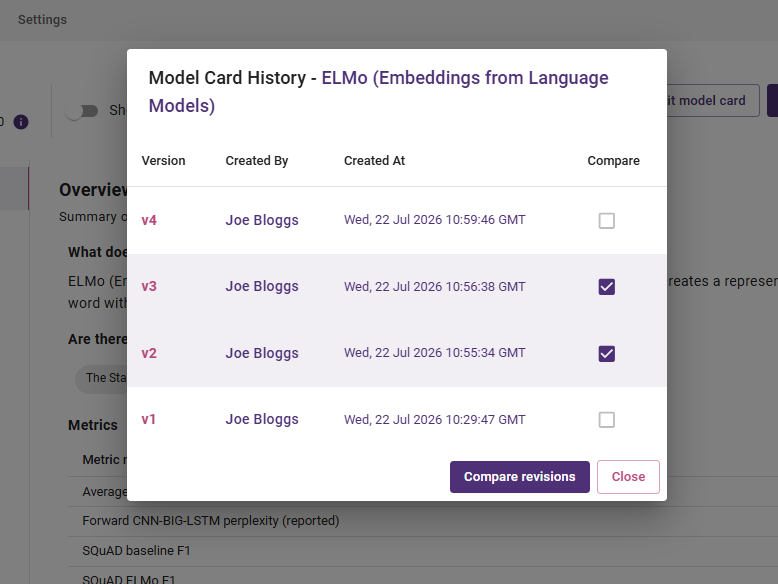
The screenshot above shows two model card versions selected for comparison.
Comparing model cards
After selecting two model cards, the comparison page displays their content side by side. This allows you to identify differences between the selected cards.
The comparison can be used to review changes to:
- Model summaries
- Intended use
- Training methodology
- Performance metrics
- Known limitations
- Lifecycle and status information
- Other fields defined by the model card schema
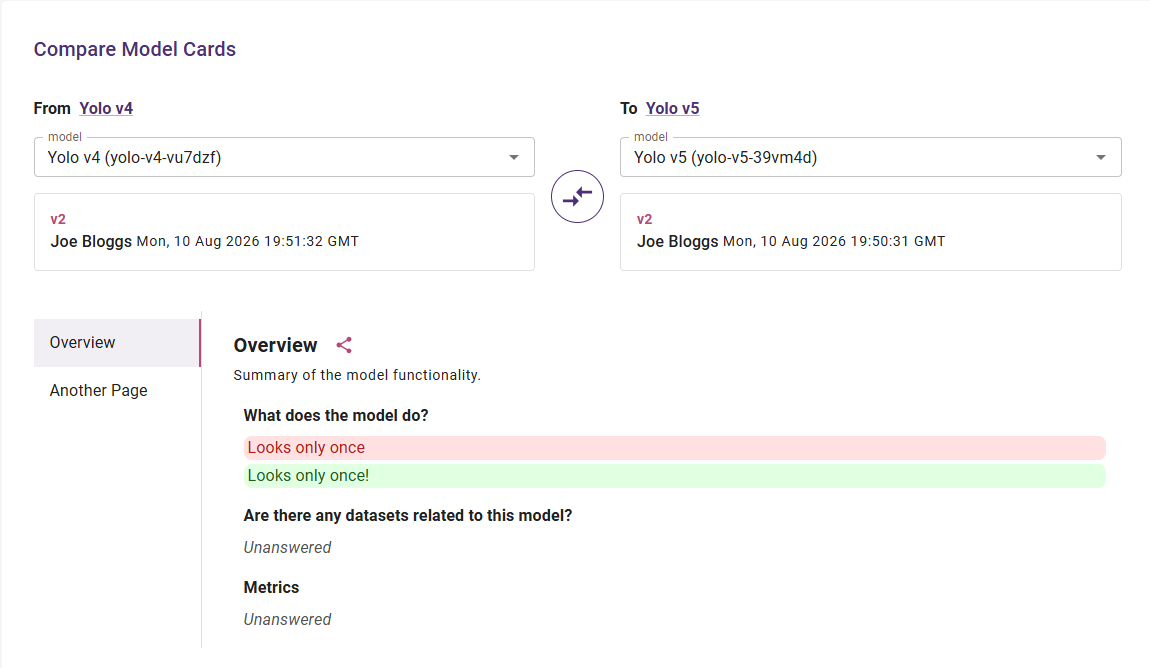
The screenshot above shows the model card comparison page, where the selected model cards are displayed.
Comparing versions of the same model
When comparing versions of the same model, you can review how the model card has changed over time.
For example, you might compare:
- The current version with an earlier version
- A version before and after a model lifecycle status update
- Two versions created during a review
- A released model card with its latest draft
Each edit to a model card creates a new version. Comparing versions helps you understand what information was added, updated, or removed between those versions.
Comparing cards from different models
Model card comparison also allows you to select cards from different models. This can help you review the documentation for related or alternative models.
When comparing different models, consider whether:
- The models use the same model card schema
- The fields contain equivalent information
- The models have different intended uses or limitations
- Differences are caused by the models themselves or by the information recorded in their cards
The comparison shows the information recorded in each selected model card. It does not indicate that one model is better or more suitable than the other.
Mirrored models
Mirrored model cards can also be included in model card comparisons.
When comparing a mirrored model with a non-mirrored model, Bailo compares:
- The read-only source card from the mirrored model
- The editable local card from the non-mirrored model
Locally added information on the mirrored model is not used as the primary card in this comparison. The revision selector therefore shows source-card revisions for the mirrored model and local-card revisions for the non-mirrored model.
This behaviour is based on the model type rather than its position in the comparison. Swapping the From and To models does not change which card is used. The mirrored source content remains read-only and is not overwritten or changed by the comparison.
Related pages
- Model Card - Filling in the model card and configuring access
- Model Card Lifecycle - Completing and updating model card lifecycle reviews
- Editing Mirrored Model Cards - Editing additional information on mirrored model cards
Copyright © Crown Copyright 2026.