
- Overview
- Getting Started
- Quick Start Guide
- Core Concepts
- Users
- Models
- Creating a Model
- Model Card
- Model Card
- Importing Model Card Text
- Comparing Model Cards
- Creating a Release
- Uploading Files
- Uploading Images
- Model Templating
- Data Cards
- Creating a Data Card
- Managing Data Cards
- Using a Model
- Browsing the Marketplace
- Access Requests
- Deployment Assessments
- Using a Pushed Docker Image
- Downloading Files
- Reviews
- Understanding Reviews
- Reviewing
- Reviewing a Release
- Reviewing an Access Request
- Reviewing a Model Card Lifecycle
- Review Outcomes
- Security Scanning
- File Scanning
- Image Scanning
- Inferencing
- Creating an Inference Service
- Managing Inference Services
- Model Mirroring
- Creating a Mirrored Model
- Editing a Mirrored Model Card
- Untrusted Models
- Untrusted Models
- Deletion
- Deleting a File
- Deleting a Model
- Soft Deletion
- Bailo Metrics
- Viewing Bailo Metrics
- Programmatic Access
- Authentication
- Personal Access Tokens
- Python Client
- OpenAPI Reference
- Webhooks
- Administration
- Getting Started
- Deployment Architecture
- App Configuration
- Model Lifecycle Configuration
- LLM
- LLM Import
- Schemas
- Understanding Schemas
- Create a Schema
- Upload a Schema
- Schema Migrations
- Review Roles
- Managing Review Roles
- Assigning Roles to Schemas
- Federation
- Peer Integration
- Microservices
- Artefact Scanners
- Helm
- Basic Usage
- Configuration
- Isolated Environments
- Migrations
- Bailo v0.4
- Bailo v2.0
- DataBase Scripts
- Reference
- Glossary
- Roles & Permissions
- Troubleshooting & FAQ
Upload a Schema
Common questions this page answers:
- How do I upload a schema to Bailo?
- What fields are required when uploading a schema?
- How do I deactivate a schema?
Upload new schemas from the schema management page. You must hold the admin role to manage schemas.
By default Bailo comes with a default schema for each schema type: model card, data card, access request and Deployment
Assessment. These are added on startup by addDefaultSchemas in backend/src/services/schema.ts, using the values in
backend/config/default.cjs. These contain a small number of questions, and are not expected to be used on a production
system.
- To add a new schema, click Schemas in the left navigation bar on a running Bailo instance.
- Click the Upload a new Schema button in the top left.
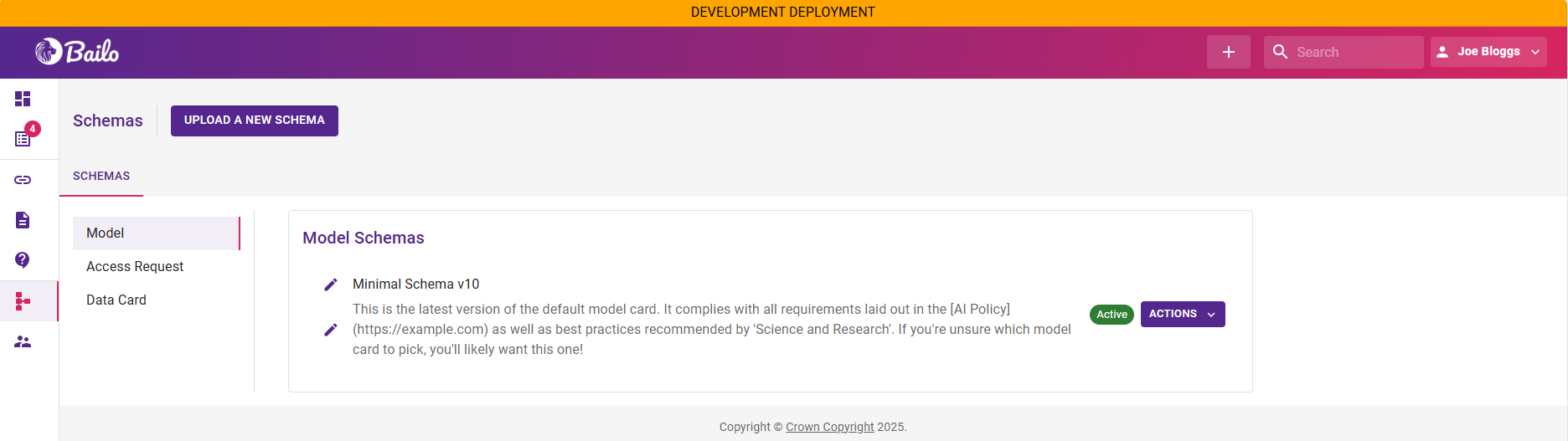
The screenshot above shows the Schemas page on the Model tab, with a populated schema called Minimal Schema v10 displaying the Actions button to one side. An Upload a new Schema is prominently displayed at the top of the page.
- Populate the form to create a new schema with fields:
- Id - A globally unique schema identifier, should include the schema version.
- Name - A user-facing name for the schema, should include the schema version.
- Description - Displayed to the user to help them decide which schema to pick. Can include markdown.
- Schema Type - Either 'Model', 'Access Request', 'Data Card' or 'Deployment Assessment'.
- Schema - Select a JSON Schema that includes the questions you require.
From the schema list page you can also convert a schema to inactive by pressing the make inactive button in the Actions menu. If a schema is deleted, any models associated with it will be deleted. Converting a schema to 'inactive' reduces it's priority within the UI but does not break any existing models uploaded with it.
Deployment Assessment schemas
Bailo automatically adds two required sections to every Deployment Assessment schema:
- Model Overview - the list of models included in the assessment. At least one model must be selected.
- Deployment Sign-Off - the Deployment Risk Owner. Exactly one user must be selected, and it defaults to the person creating the assessment.
These sections appear after the sections in your uploaded schema. The assessment name is also requested at the top of the form, but it is not part of the schema.
These questions are used throughout the application, for example to show an assessment on the model's Deployment Assessments tab and to notify the relevant people when it is published, so they are provided automatically. This allows schemas provided by Bailo administrators to be otherwise entirely customisable.
Customising the automatic sections
To add your own questions to either section, include a modelOverview or signOff object in your schema. Their
properties appear alongside the automatic questions, and any required entries are added to the automatic ones. If your
schema includes one of these sections, it keeps the position you give it. The section titles cannot be changed.
To replace an automatic question, for example to give the Deployment Risk Owner question a custom description, define a
property with the same name (modelIds or riskOwners). It replaces the automatic question completely, so it must
include everything the question needs to work. For example:
"signOff": {
  "properties": {
    "riskOwners": {
      "title": "Who is the Deployment Risk Owner?",
      "description": "Your custom guidance for the Deployment Risk Owner.",
      "type": "array",
      "items": { "type": "string", "minLength": 1 },
      "minItems": 1,
      "maxItems": 1,
      "uniqueItems": true,
      "widget": "entitySelector"
    }
  }
}
Use "widget": "modelSelector" and omit maxItems when replacing modelIds. Bailo does not check that a replacement
is complete when the schema is uploaded, so test it by creating an assessment.
Copyright © Crown Copyright 2026.